 AnyTime News
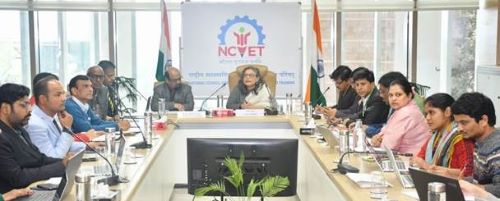
80 qualifications approved at NSQC’s 45th meeting, yet concerns over unemployment and skill gaps remain unresolved
ANYTIEM NEWS NETWORK The 45th meeting of the National Skills Qualifications Committee (NSQC) was held on February 6, 2026, under the chairpersonship oF Debashree Mukherjee, Secretary of the Ministry of Skill Development and Entrepreneurship (MSDE) and Chairperson of the National Council for Vocational Education and Training (NCVET). While the meeting focused on improving the quality and industry relevance of vocational qualifications across the country, experts believe that longstanding challenges in India’s skill development ecosystem continue to raise serious questions.
The meeting was attended by NCVET Executive Member Prof. (Dr.) Ashok Kumar Gaba, Director and Secretary Dr. Suhas Deshmukh, along with representatives from the Ministry of Rural Development, the Ministry of Labour and Employment, sector experts, and key stakeholders. A total of 15 awarding bodies presented their qualifications, with 80 proposals reviewed, including those from the Directorate General of Training (DGT), NIELIT, IN-SPACe, and various Sector Skill Councils.
Although the committee emphasized high-growth sectors such as automotive, electronics, IT-ITeS, healthcare, aerospace, logistics, green jobs, manufacturing, tourism, and emerging technologies, a critical question remains — will these newly approved courses actually translate into jobs? Several existing skill programs have faced criticism for producing certified candidates who still struggle to find meaningful employment.
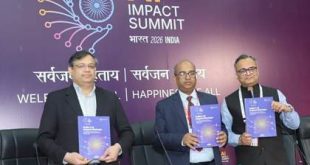
One of the major highlights of the meeting was the approval of Artificial Intelligence-related courses under the “Skilling for AI Readiness (SOAR)” initiative, linked to the pre-event of the India AI Impact Summit 2026. However, experts argue that the push for digital and AI skills may remain incomplete unless adequate infrastructure, qualified trainers, and quality training reach rural areas and smaller towns.
The committee stressed outcome-based design, rigorous assessment standards, curriculum relevance, and industry validation. Despite these assurances, industries have repeatedly pointed out that many trained candidates lack practical, job-ready skills. In such a scenario, merely approving new qualifications may not be enough to bridge the widening gap between training and employment.
Addressing the meeting, Ms. Mukherjee highlighted the importance of strengthening skill qualifications to match the evolving needs of the economy. She stated that the initiative reflects the government’s continued commitment to building a skilled, adaptable, and globally competitive workforce in line with the vision of Viksit Bharat 2047, the National Education Policy 2020, and the National Credit Framework.
However, the real challenge lies in translating policy into measurable outcomes. Without ensuring training quality, strong placement mechanisms, and genuine industry alignment, such initiatives risk becoming more about announcements than impact.
While the decisions taken at the 45th NSQC meeting are being projected as a step toward modernizing India’s skilling sector, their success will ultimately depend on execution. For millions of young Indians, certificates alone are not enough — what they seek is stable employment. Until that becomes a reality, skepticism around large-scale skill initiatives is unlikely to fade.