 AnyTime News
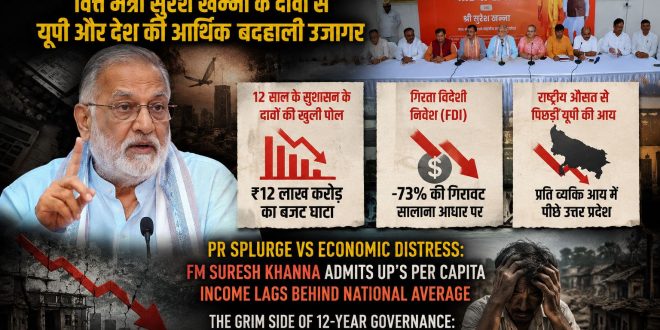
PR Splurge vs Economic Distress: FM Suresh Khanna Admits UP’s Per Capita Income Lags Behind National Average
Anytime News Network (Pooja Shrivastava):
While the ruling administration is busy orchestrating a grand public relations campaign to mark 12 years of public service, the underlying microeconomic indicators present a highly distressing picture of fiscal mismanagement. During a media interaction at the Naimisharanya VVIP Guest House, Uttar Pradesh Finance Minister Suresh Kumar Khanna attempted to put a shiny gloss on various central and state schemes. However, when confronted with hard economic data regarding soaring debt and plummeting investments, the narrative of absolute growth quickly crumbled.
The Stubborn Gap in Per Capita Income Despite the high-decibel propaganda surrounding the goal of transforming Uttar Pradesh into a ‘One Trillion Dollar Economy’, Minister Khanna had to openly concede that the state’s per capita income continues to languish far below the national benchmark. To deflect blame, he presented a comparative figure stating that the income has risen from around ₹54,000 to ₹1,08,000 under their tenure. What the minister conveniently brushed under the carpet is the bitter reality that an average citizen in Uttar Pradesh remains significantly poorer and financially weaker compared to the rest of the nation.
Normalizing a Staggering ₹12 Lakh Crore Fiscal Deficit The structural weakness of the current economic blueprint became even more glaring when the minister was questioned about the colossal ₹12 lakh crore fiscal deficit in the current financial year and the massive sovereign interest burden arising from it. Instead of laying out a serious corrective roadmap, Khanna bizarrely normalized the distress by stating, “It is a very good thing that we are paying our interest strictly on time.” Terming the heavy drain of taxpayers’ money into mere interest repayments as an achievement exposes a total lack of fiscal accountability.
The Reality of Plunging Net FDI and Rising Underemployment The structural failure to attract global capital is evident from the fact that Net Foreign Direct Investment (FDI) into India has plummeted by an alarming 50%. Despite hosting multiple star-studded Global Investors Summits, Uttar Pradesh’s actual share in net foreign inflows remains completely negligible. Furthermore, while the minister boasted about dropping unemployment rates (claiming 3.1% in 2025) and registered startups, the ground reality is plagued by institutional paper leaks, temporary contract jobs, and lack of industrial manufacturing hubs.
Similarly, the boastful projection of distributing free rations to 81.35 crore people across India—including 3.63 crore families in UP—inadvertently serves as a harsh indictment of the economic landscape. It highlights that even after a decade of complete power, a staggering majority of the population cannot afford basic sustenance without state dependency. While mega infrastructure projects like the Bundelkhand and Ganga Expressways are being highlighted as trophies of modernization, they are heavily funded through mounting public debt and toll taxes, pushing the common middle-class consumer into a corner.