 AnyTime News
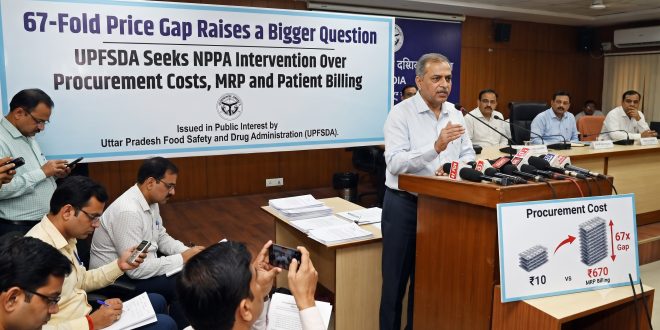
UPFSDA Seeks NPPA Intervention Over Procurement Costs, MRP and Patient Billing
Pooja Srivastava
Anytime News Network
: A massive gap between the procurement price of medicines and the amount charged to patients in hospital pharmacies has pushed the issue onto the national regulatory agenda. The Uttar Pradesh Food Safety and Drug Administration (UPFSDA) has approached the National Pharmaceutical Pricing Authority (NPPA) seeking effective regulatory intervention over unusually high differences in medicine pricing.
According to the department, inspections of more than 200 pharmacies across 22 medical colleges and 30 government and private hospitals found significant differences between institutional procurement prices, described as Price to Retailer (PTR), and prices charged to patients. In some cases, the difference was reported to be as high as 67 times.
Who Gets the Discount?
The central question raised by UPFSDA is straightforward: when hospitals procure medicines from manufacturers or suppliers at substantial discounts, how much of that benefit actually reaches the patient?
The department has pointed out that printed MRP may remain the visible benchmark even when institutional purchases are made at heavily discounted rates. A patient may therefore see an MRP-based discount without knowing the hospital’s actual procurement cost.
Same Brand, Different MRP
Another concern communicated to NPPA involves instances where medicines carrying the same manufacturer and brand name were reportedly supplied institutionally with different MRPs.
The department has also flagged contract-manufactured brands that may not be readily available in the surrounding retail market. According to the concerns placed before NPPA, limited alternatives could increase patient dependence on hospital supply channels.
Four Regulatory Demands
UPFSDA Commissioner Dr. Roshan Jacob has urged NPPA to consider four major measures: capping trade margins on high-MRP medicines and medical devices; rationalising MRP determination; considering highly high-margin hospital-supply medicines for inclusion under price control; and strengthening regulatory action against violations of DPCO provisions.
The Real Test
UPFSDA has also cited the “cost-plus” model used in government medical colleges for certain expensive medicines, including high-end antibiotics, injections and cancer drugs, as an example of how institutional procurement benefits could potentially reach patients.
The department’s message to the national regulator is clear: a discount printed on an invoice or package cannot by itself establish genuine affordability.
When procurement and patient billing can reportedly differ by as much as 67 times, the issue moves beyond pricing—it becomes a question of transparency, regulation and accountability across the medicine supply chain.