 AnyTime News
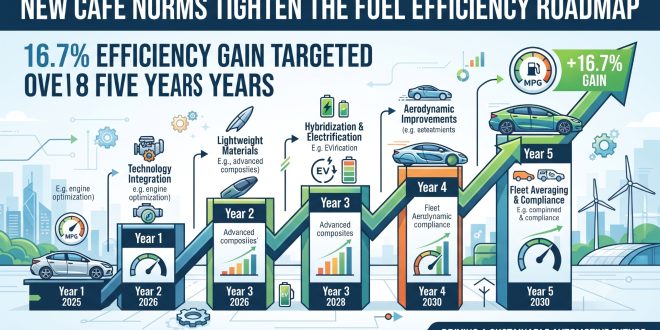
16.7% efficiency gain targeted over five years
Pooja Srivastava
Anytime News Network
India has tightened the regulatory framework for passenger vehicle fuel efficiency with the notification of new Corporate Average Fuel Economy (CAFE) Norms, setting a tougher five-year roadmap for cleaner, more efficient and technology-driven mobility.
The new norms will come into force from April 1, 2027, and remain applicable until March 31, 2032. They will cover new passenger vehicles manufactured or imported for sale in India.
Efficiency target gets tougher
The fuel-consumption benchmark will decline progressively from 3.996 litres per 100 km in 2027-28 to 3.3273 litres per 100 km in 2031-32. This represents an improvement of approximately 16.7% over the five-year period.
Weight-sensitive approach
The revised framework introduces a more balanced, weight-sensitive target structure. Relatively lighter vehicles will face comparatively softer targets, while heavier vehicles will be required to achieve greater fuel efficiency. The reference weight has been raised from 1,082 kg to 1,229 kg, reflecting changes in India’s passenger vehicle fleet.
Technology gets a wider runway
The new framework gives manufacturers greater freedom to choose their technology pathway. Electric vehicles, hybrids, alternative fuels and advanced energy-efficiency solutions will have a stronger role in meeting fleet-level obligations.
Technologies such as solar-reflective paints, advanced glazing and high-efficiency air-conditioning systems will also receive recognition for their contribution to improved efficiency.
Cleaner fuels gain recognition
The framework introduces a Carbon Neutrality Factor (CNF) to recognise the contribution of ethanol-blended petrol, biofuels and compressed biogas. This creates an additional compliance pathway while supporting India’s broader transition towards renewable and lower-carbon fuels.
EVs receive a boost
Battery Electric Vehicles, Range-Extended Electric Vehicles, Plug-in Hybrid Electric Vehicles, Strong Hybrid Electric Vehicles and Flex-Fuel Vehicles will receive volume derogation factors, popularly described as ‘super credits’, in fleet-average calculations.
The recognised fuel-conservation technologies have also been expanded from four to twelve, giving manufacturers a broader technology basket.
Compliance gets flexibility
Manufacturers exceeding prescribed targets can generate credits, while eligible manufacturers facing compliance gaps can use carry-forward provisions, exchange or trade credits, or purchase credits through the Bureau of Energy Efficiency’s buyout mechanism.
Manufacturers with annual sales below 1,000 units will remain exempt from fleet-average obligations.
Towards global testing
Reporting under both the Modified Indian Driving Cycle (MIDC) and Worldwide Harmonized Light Vehicles Test Procedure (WLTP) will support India’s gradual transition towards globally harmonised testing practices.
The new CAFE regime marks a significant policy push towards lower fuel consumption, stronger energy security and a more sustainable automotive future.