 AnyTime News
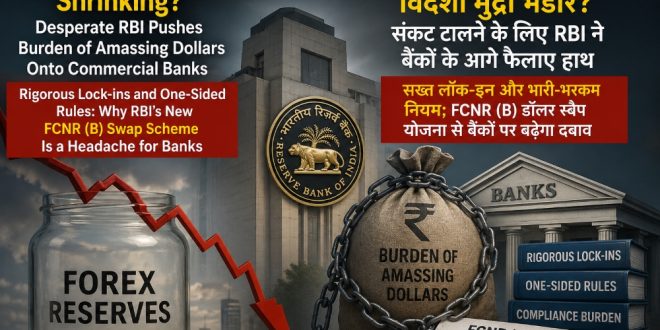
Rigorous Lock-ins and One-Sided Rules: Why RBI’s New FCNR (B) Swap Scheme Is a Headache for Banks
(By Pooja Srivastava, Anytime News Network)
Amid growing concerns over the stability of the rupee and geopolitical shifts affecting national reserves, the Reserve Bank of India (RBI) has introduced a fresh FCNR (B) dollar-rupee swap window. Critics and financial analysts view this abrupt move as a desperate attempt by the central bank to shore up its forex reserves by outsourcing the pressure of mobilizing foreign currency directly to commercial banks.
Under the new directives, banks are being nudged to attract high-cost Foreign Currency Non-Resident (B) deposits with long-term maturities of 3 to 5 years. However, the operational features of this facility reveal deep structural imbalances that disadvantage the banking sector. The RBI has mandated that banks maintain an independent and exhaustive audit trail for these conversions, massively increasing regulatory compliance costs and administrative workloads.
The most punishing clause of this scheme lies in its uneven exit policy. While depositors may be allowed premature withdrawals after a year based on internal banking policies, the corresponding swap contract executed with the RBI remains entirely irrevocable. This means if an NRI investor pulls their funds out early, commercial banks will still be stuck holding the un-cancellable contract with the RBI, absorbing all the liquidity and conversion risks entirely on their own balance sheets.
Furthermore, restricting banks to access this window only once a week adds unnecessary operational friction. With the window effectively slamming shut on October 16, 2026, banks are racing against a tight deadline in a highly volatile global market. Instead of addressing core macroeconomic issues, this policy shifts the anxiety of defending the rupee squarely onto India’s banking system.