 AnyTime News
Hospital Pharmacy Pricing Under Scanner
Pooja Srivastava
Anytime News Network
Patients battling serious illnesses may be facing another financial burden inside hospital pharmacies, with a comparison conducted during inspections by the Uttar Pradesh Food Safety and Drug Administration (UPFSDA) revealing striking differences between the purchase prices of medicines and their printed maximum retail prices (MRP).
The inspections covered 214 hospital pharmacies across medical colleges and private hospitals. Of 130 medicines analysed, 36 had MRPs more than ten times their pharmacy purchase prices, with the gap reaching nearly 67 times in some cases.
₹74 Drug, ₹4,980 MRP
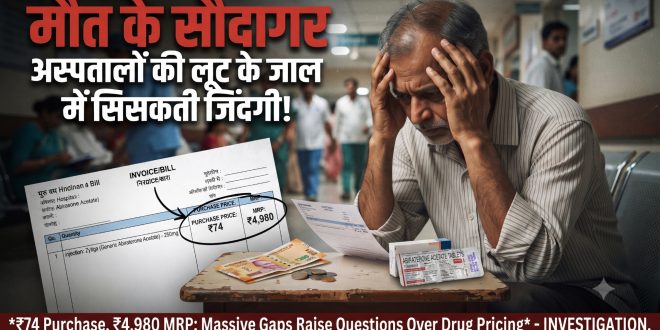
One of the most striking examples was Polymyxin-B Injection. GUFIPOL 500,000 Unit was reportedly purchased by a pharmacy for ₹74.09, while its printed MRP stood at ₹4,980.94—nearly 67 times the purchase price.
₹56 Purchase, ₹3,050 MRP
The gap was also substantial in Terlipressin Injection, used in certain serious medical conditions. Its purchase price was recorded at ₹56 against an MRP of ₹3,050.
Similarly, Colistimethate Sodium 4.5 MIU was purchased for ₹210 while its MRP was ₹9,702.31. Tigecycline 50 mg showed a purchase price of ₹154.54 against an MRP of ₹7,110.47.
ICU Drugs Raise Concern
What makes the findings particularly significant is that several of the medicines involved are injectable drugs used in serious infections, intensive-care settings and complex medical conditions.
Caspofungin 70 mg, for instance, was recorded at a purchase price of ₹800 for one brand, against an MRP of ₹21,230.
Cancer Medicine Gap
The disparity was also substantial in expensive cancer medicines. Bevacizumab 400 mg had a recorded purchase price of ₹7,541.10 against an MRP of ₹69,995—a difference of ₹62,453.90 per unit.
Medical Devices Too
The pricing gap was not limited to medicines. A 3-way stop cock was reportedly purchased for ₹6.40 while its MRP was ₹163. Another medical device had a purchase price of ₹20.95 against an MRP of ₹500.
Who Benefits From the Gap?
The findings raise serious questions about pricing structures and trade margins in hospital pharmacies. Where a medicine is procured at a fraction of its printed MRP, the critical question is whether the resulting margin is transparently passed on to patients or becomes part of the commercial structure between manufacturers, suppliers and hospitals.
A large MRP can also create room for discounts that appear substantial to consumers while still leaving considerable margins over the actual procurement cost.
The issue, therefore, is not merely the printed price on a medicine pack. It is about transparency, accountability and whether patients are receiving the real benefit of low procurement costs.