 AnyTime News
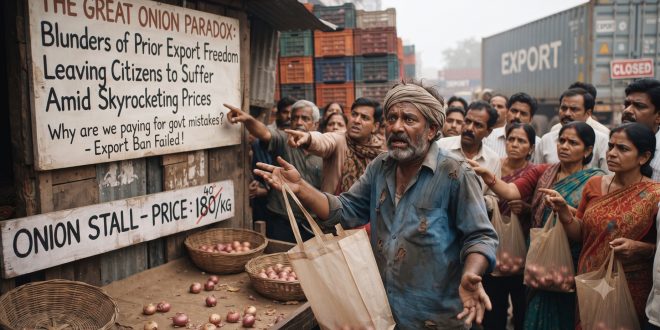
Buffer stock releases begin as seasonal demand approaches—if demand was predictable, why were exports allowed to continue? Questions grow over the government’s reactive approach
Pooja Srivastava
Anytime News Network
The government has stepped in to control possible seasonal pressure on onion prices by releasing buffer stocks and moving supplies from producing regions to major consumption centres. The first Kanda Express has left Nashik for Delhi, while road transport is being used for cities including Lucknow, Varanasi, Patna, Kolkata and Chennai. Retail onions are set to be sold at ₹35 per kg through NCCF, NAFED and Kendriya Bhandar outlets and mobile vans.
The government says onion availability is comfortable, with estimated production of 307.37 lakh tonnes in 2025-26, broadly similar to the previous year. Yet the intervention raises an uncomfortable question: if the government already knew that demand normally rises during Onam, Ganesh Chaturthi, Durga Puja, Dussehra, Diwali and the wedding season, why was stronger market planning not put in place earlier?
The government had targeted procurement of 2 lakh tonnes of Rabi onion for the 2026-27 buffer and has so far procured around 1.21 lakh tonnes. At the same time, onion exports during April-June 2026 reportedly reached around 3.82 lakh tonnes.
This is where questions over policy coordination become unavoidable. If seasonal demand and price pressure were foreseeable, should domestic availability not have received greater priority before allowing substantial exports?
The government is now using buffer stocks to sell onions at a controlled price. While such intervention may provide short-term relief to consumers, it also highlights a familiar concern: why does policy intervention often arrive after market pressure has already begun?
The role of intermediaries and the supply chain also deserves closer scrutiny. Farmers may not always receive the benefit of higher retail prices, while consumers can face a sharp increase in their household expenses. The crucial question is therefore not simply whether onions are available, but who benefits at each stage between the farm and the consumer.
The government says it is committed to balancing consumer interests with remunerative returns for farmers. That commitment will ultimately be judged by outcomes: farmers must receive fair prices, while consumers should not be forced to bear avoidable inflation.
For now, the Kanda Express may bring onions to the markets—but it also brings a larger policy question to the doorstep: could better forecasting, storage and export management have prevented the need for reactive price intervention?
News Board
Onion Prices • Buffer Stocks • Kanda Express • Export Policy • Inflation • Farmer Interests • Consumer Protection