 AnyTime News
Ceremonial recognition vs ground reality—₹18,000 honorarium fails to address core issues
Anytime News Network | Pooja Srivastava
: The Uttar Pradesh government’s decision to increase the honorarium of Shiksha Mitras from ₹10,000 to ₹18,000 per month has been presented as a landmark reform, accompanied by large-scale ceremonies and official messaging. However, beneath the celebratory narrative, significant concerns remain unresolved, raising questions about the long-term impact of this move.
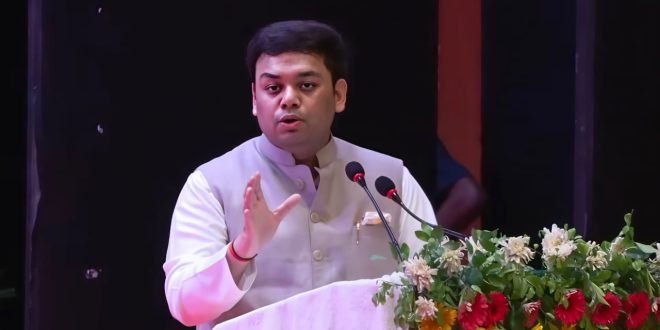
At the grand “Shiksha Mitra Samman Samaroh” in Gorakhpur, Chief Minister Yogi Adityanath symbolically distributed cheques and highlighted various achievements of the Basic Education Department. While the event projected a strong pro-education stance, many Shiksha Mitras argue that such gestures do little to resolve their persistent challenges.
Approximately 143,000 Shiksha Mitras are expected to benefit from the revised honorarium. Yet, stakeholders point out that inflation, lack of job security, and the absence of regularization continue to overshadow this financial relief. For years, demands for permanent employment status have remained pending, and critics suggest that periodic increments may be diverting attention from these structural issues.
Basic Education Minister Sandeep Singh emphasized the government’s achievements since 2017, including infrastructure upgrades under “Operation Kayakalp” and digital initiatives like smart classrooms, ICT labs, and tablet distribution. However, reports from rural areas indicate gaps in implementation, maintenance, and effective utilization of these resources.
Similarly, the introduction of NCERT curriculum in government schools has been positioned as a step toward bridging the gap with private institutions. Yet, education experts argue that curriculum alignment alone cannot ensure quality education without parallel improvements in teacher training, accountability, and learning outcomes.
Efforts to strengthen girls’ education, including the expansion of Kasturba Gandhi residential schools and direct benefit transfers for uniforms and essentials, have been acknowledged. Still, concerns regarding execution efficiency and monitoring persist.
While the government’s announcement and the accompanying ceremonies underline its intent to showcase progress, critics maintain that the fundamental expectations of Shiksha Mitras—job stability, fair compensation structures, and long-term policy clarity—remain largely unmet.
In this context, the honorarium hike appears more like a temporary relief measure rather than a comprehensive solution, leaving the larger question of systemic reform unanswered.