 AnyTime News
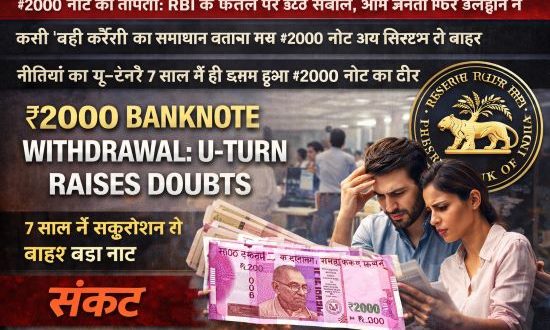
From ‘Emergency Currency’ to Exit: The Short Life of the ₹2000 Note
Anytime News Network | Pooja Srivastava
The decision to withdraw the ₹2000 denomination banknote from circulation has reignited debate over India’s currency management policies and the long-term planning behind major financial decisions. Once introduced as a critical solution during the 2016 demonetisation crisis, the note is now being phased out, raising concerns about policy consistency and economic messaging.
The ₹2000 banknote was introduced in November 2016 under Section 24(1) of the RBI Act, 1934, primarily to quickly replenish currency in circulation after the sudden withdrawal of ₹500 and ₹1000 notes. At the time, the government and the Reserve Bank of India projected the high-value note as a temporary yet necessary step to stabilise the cash-driven economy.
However, less than a decade later, the central bank has decided to withdraw the denomination from circulation under its “Clean Note Policy.” While the note will continue to remain legal tender, banks have been instructed to stop issuing it immediately, and citizens were asked to deposit or exchange the notes within a defined time frame.
Critics argue that the move exposes the uncertain trajectory of India’s currency management strategy. Economic observers point out that the ₹2000 note, once representing 37.3 percent of total currency in circulation in March 2018 with a value of ₹6.73 lakh crore, saw a dramatic decline to ₹3.62 lakh crore by March 2023 — only about 10.8 percent of total notes in circulation.
According to RBI data, nearly 89 percent of ₹2000 banknotes were printed before March 2017 and have now reached the end of their estimated life span of four to five years. But critics say the bigger issue lies not in the age of the notes but in the broader policy decisions surrounding their introduction and withdrawal.
Another key concern highlighted by financial analysts is the practical inconvenience faced by citizens and small businesses. Even though people can deposit these notes without restriction and exchange up to ₹20,000 at a time at bank branches, the logistical burden of handling large volumes of high-value notes has once again fallen on the public.
Additionally, economists argue that the short operational life of the ₹2000 note reflects a larger structural problem: the lack of clarity in India’s long-term cash management strategy. The note was initially introduced to address an urgent liquidity crisis, but its withdrawal suggests that policymakers may now see it as unnecessary or even counterproductive for everyday transactions.
As the banking system adjusts to the removal of the ₹2000 note from active circulation, the episode is likely to remain a key example in discussions about financial governance, currency planning, and the long-term credibility of economic policymaking in India.