 AnyTime News
New Player or Political Decoy? Confusion Deepens as Traditional Parties Hold Ground
Anytime News Network
By Pooja Srivastava
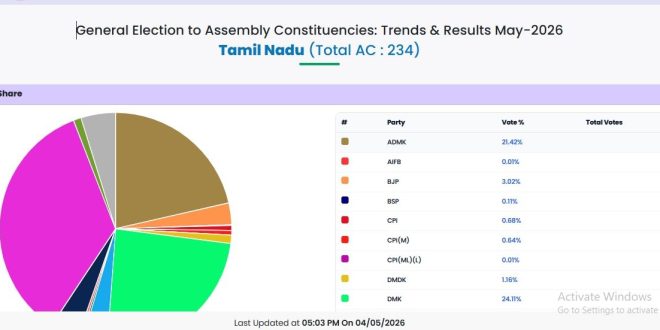
The unfolding election scenario in Tamil Nadu has sparked a wave of skepticism, with early trends indicating a surprising surge by Tamilaga Vetri Kazhagam, while established players like Dravida Munnetra Kazhagam and All India Anna Dravida Munnetra Kazhagam continue to maintain a strong foothold. The bigger question, however, is whether these results truly reflect public will—or a carefully engineered political narrative.
Politics in India increasingly appears less about ideology and more about strategy and perception management. Tamil Nadu’s evolving electoral picture reinforces the idea that elections are turning into an “adventure game,” where unpredictability often overshadows policy-driven discourse. The sudden rise of a relatively new party raises eyebrows: is it a genuine public movement, or a calculated distraction designed to shift focus away from governance failures?
Looking at the numbers, TVK leads in over 100 constituencies, while DMK and AIADMK remain competitive. Instead of delivering a clear mandate, the situation reflects a fragmented and potentially confusing verdict. This raises concerns about whether voters are making informed decisions based on manifestos—or being influenced by narratives crafted during high-pitched campaigns.
Political observers argue that emotional appeal, branding, and strategic positioning seem to have outweighed substantive policy debates. Meanwhile, the marginal presence of parties like Congress, BJP, and Left groups suggests a shrinking space for national-level influence in the state’s political landscape.
The broader concern remains: is democracy being shaped by genuine public choice, or by tactical experimentation within political ecosystems? Tamil Nadu’s current electoral trends highlight a deeper issue—where perception may be overtaking principle, and where clarity of mandate is increasingly elusive.