 AnyTime News
Cabinet Approves Higher MSP for Kharif Crops for 2026-27 Season
Pooja Srivastava | Anytime News Network
The Cabinet Committee on Economic Affairs, chaired by Narendra Modi, has approved an increase in the Minimum Support Price (MSP) for 14 Kharif crops for the 2026-27 marketing season. The government stated that the revised MSP structure aims to ensure remunerative prices for farmers and strengthen the agricultural economy.
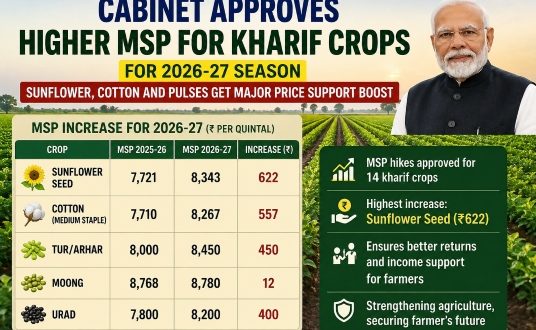
Among all crops, sunflower seed received the highest MSP hike of ₹622 per quintal, followed by cotton with an increase of ₹557, nigerseed by ₹515, and sesame by ₹500 per quintal. The MSP for common paddy has been fixed at ₹2441 per quintal, while tur/arhar has been priced at ₹8450 per quintal.
According to the government, the revised MSP rates are in line with the policy of fixing support prices at least 1.5 times the all-India weighted average cost of production. Farmers cultivating moong are expected to receive the highest margin of 61 percent over production cost, while bajra and maize are projected to offer margins of 56 percent and arhar around 54 percent.
The Centre said it has been consistently encouraging the cultivation of pulses, oilseeds, and nutri-cereals through higher MSP incentives in recent years. Official figures show that paddy procurement between 2014-15 and 2025-26 reached 8418 lakh metric tonnes, compared to 4590 lakh metric tonnes during 2004-05 to 2013-14.
Similarly, the total MSP payout to paddy farmers during 2014-15 to 2025-26 stood at ₹16.08 lakh crore, significantly higher than ₹4.44 lakh crore paid during the previous decade. Overall payments to farmers cultivating 14 Kharif crops also witnessed a sharp increase during the same period.
Agriculture experts believe that the revised MSP will provide relief to farmers ahead of the upcoming Kharif season, though concerns remain regarding procurement efficiency, storage infrastructure and the impact on food inflation. Analysts suggest that merely increasing MSP may not be sufficient unless procurement mechanisms are strengthened at the grassroots level.
The move is being viewed as a major policy decision aimed at boosting rural income, encouraging crop diversification and supporting India’s farm economy during the 2026-27 agricultural cycle.