 AnyTime News
Door-to-Door VIS Campaign Raises Risks of Errors and Voter Confusion
Pooja Srivastava | Anytime News Network
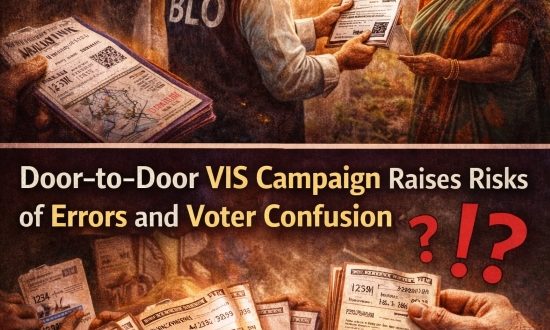
As preparations for the 2026 legislative assembly elections intensify, the Election Commission of India has begun distributing Voter Information Slips (VIS) in Tamil Nadu and West Bengal ahead of Phase-I polling on April 23. While the initiative aims to streamline voter participation, it has also triggered concerns regarding execution and transparency.
The VIS includes key voter details, polling station location, timing, and guidelines, along with QR codes for quick verification. However, the fact that VIS cannot be used as a standalone identity proof for voting has created confusion among voters, raising questions about its practical utility.
The distribution process, being carried out door-to-door by Booth Level Officers (BLOs), involves a massive logistical exercise. Experts warn that such large-scale operations are prone to delays, inaccuracies, and even potential misuse.
The Commission has also cautioned against unauthorized possession or distribution of VIS, stating that violations under the Representation of the People Act, 1951 could lead to penalties, including imprisonment or fines. This highlights underlying concerns about possible misuse of election materials.
Although the introduction of Accessible Voter Information Slips (AVIS) with Braille features for visually impaired voters is a positive step, questions remain about its effective implementation on the ground.
Overall, while the initiative is designed to improve voter awareness and reduce crowding at polling stations, concerns over execution gaps, voter confusion, and transparency risks continue to cast a shadow over the process.